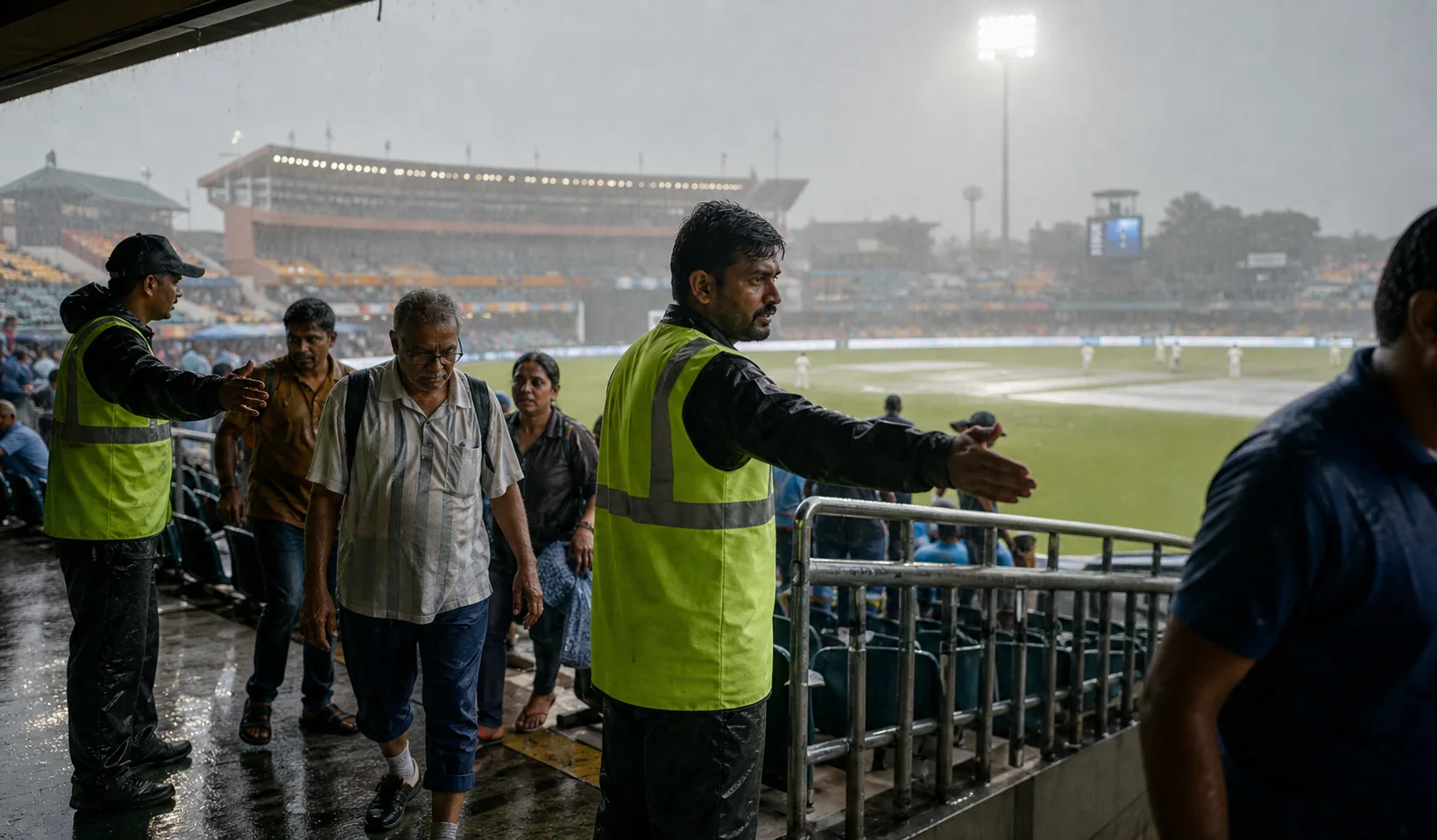
Weather response at an open venue is not a single evacuation order. In monsoon conditions, organisers may need to pause play, protect exposed equipment, keep people away from vulnerable structures, open sheltered areas, or release crowds in phases. The plan should distinguish these states and name the person who can move from one to another after consulting the appropriate safety information. The resulting plan should be simple enough for an event supervisor to apply without opening a technical manual. This frames the work as an operating capability rather than a technology purchase.
Walk every route when wet. Smooth finishes, painted lines, temporary cable ramps, stair edges, drainage grates, and low-lit service paths can all change how people move. Record where water accumulates, where wheelchairs may struggle, and where a crowd would naturally seek cover. Correcting a small surface or drainage issue before doors open can matter more than adding another digital alert. That discipline keeps investment choices connected to a credible event-day workflow. Name the owner, the handoff point, and the manual fallback before approving a design. Build the procedure with facilities, customer-facing teams, and technical staff in the same room.
The communications plan must survive noise, rain, and partial mobile congestion. Prepare short public messages in the local languages appropriate to the event, use visual symbols consistently, and brief stewards on the exact wording for each status. Fans should hear what action to take, where to go, and what information will follow; technical weather terminology rarely helps a person in a queue. It also gives the team a practical basis for changing the approach after a debrief. The decision should be tested against the people who will use it under event pressure.
Shelter capacity needs an honest inventory. Identify which indoor rooms, covered concourses, and transport areas are safe and accessible, then calculate usable space after operational exclusions. Do not promise shelter for everyone unless it exists. Where managed release is safer, explain the route, transport coordination, and reunion arrangements for families or groups separated by the response. The point is a clear operational choice rather than a more elaborate technical description. Keep the public experience, staff workload, and safety consequence visible in the decision. Choose controls that reduce a defined risk without quietly shifting it to another group.
Decision support should use more than a single forecast screen. Monitor official alerts, local conditions, surface observations, power resilience, and transport status, and keep a time-stamped decision log. The log helps a multi-agency team explain why it paused, sheltered, or released people. It also prevents later recollection from replacing the facts available at the time. This keeps the arrangement understandable to the people who must act on it. Use a documented review point so assumptions can be revised rather than defended. Keep a concise record of exceptions, because recurring exceptions reveal design debt.
Equipment continuity deserves a separate checklist. Protect broadcast and electrical work safely, but do not allow equipment recovery to obstruct crowd routes or distract safety staff. Confirm backup lighting, public address, radio batteries, and dry storage for mobility aids. A response can appear orderly until darkness, a soaked radio, or an inaccessible exit exposes a neglected dependency. The same record can support a fair review when a decision is questioned later. Any partner involved should understand both its technical role and its authority boundary. Roll out in a bounded pilot where a supervisor can reverse the change quickly.
Rehearse with a scenario that includes uncertainty. Ask teams to respond to a changing forecast, a blocked corridor, and a late transport update rather than a perfect scripted alarm. Capture delays, confused handoffs, and accessibility issues without blame. The purpose is to build a shared operating picture that still works when a rain-affected event becomes uncomfortable, noisy, and time constrained. That makes the next event safer to run and the system easier to maintain. Good practice preserves a workable service when the preferred digital path is unavailable. Use the debrief to replace anecdote with a specific adjustment for the next event.