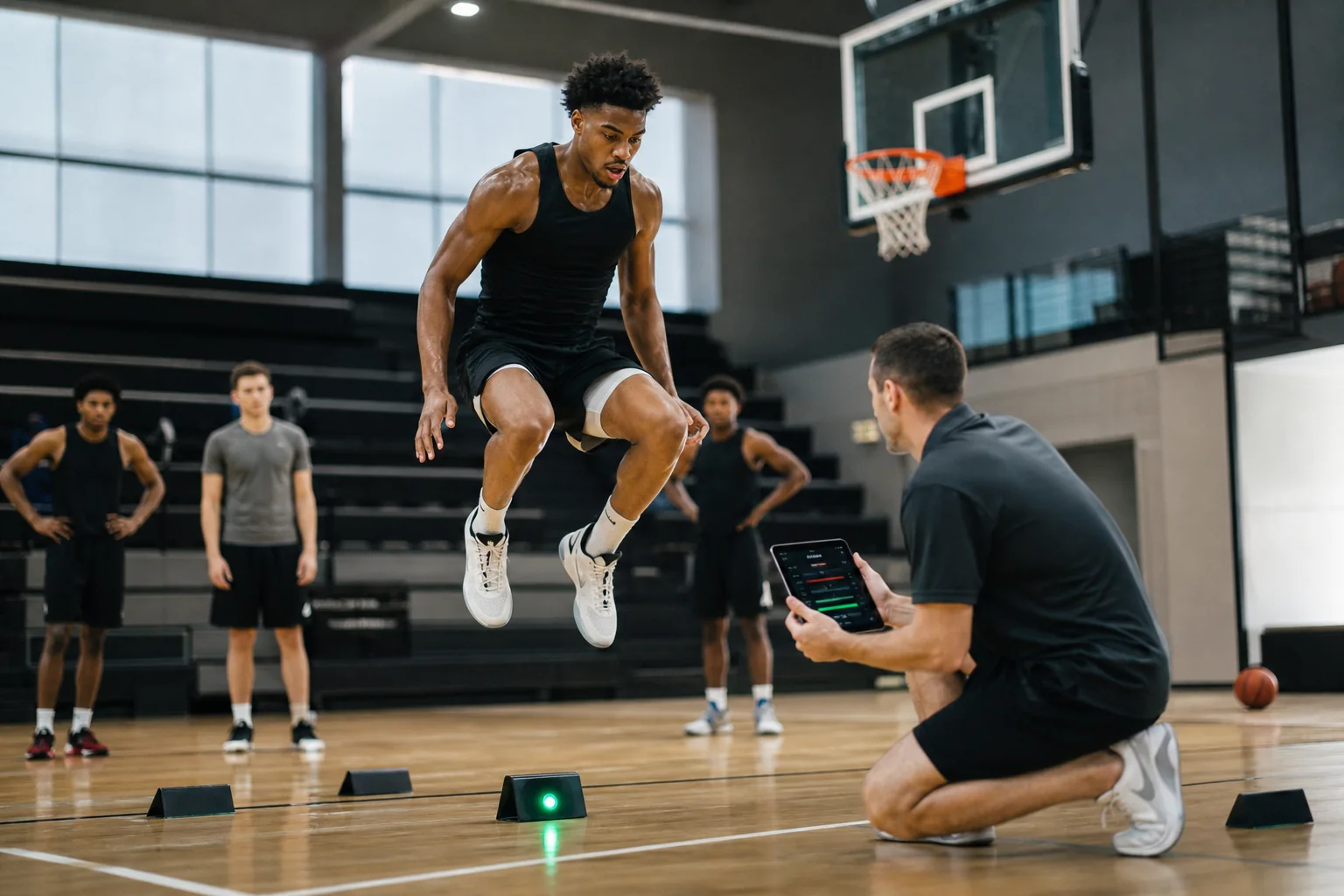
Basketball practice repeatedly asks athletes to accelerate, jump, absorb force, reorient, and make another decision before the first landing has fully settled. A useful programme therefore treats landing as part of the game sequence. Start by observing the actual actions the team needs: contested rebounds, closeouts, layup landings, short drop steps, or lateral recoveries. Choose one or two actions for a block and define what “good enough” looks like in terms of balance, space awareness, repeatability, and ability to move again. Avoid presenting one body shape as the only safe or effective answer.
Introduce exposure through predictable, low-chaos tasks before adding competition. An athlete might catch, land, stabilise briefly, and pass; then land into a change of direction; then respond to a live defender. The progression is not simply higher boxes or more repetitions. It is an increase in relevant information and demand. Keep landing surfaces clear, check footwear and court conditions, and give athletes enough recovery between early attempts to feel the movement. The goal is to build a repertoire of controlled responses, not to create fatigue that disguises the learning signal.
Use coaching cues that connect to outcome. “Find your next step,” “arrive quiet enough to see,” or “own the space before the outlet” can be more useful than a lengthy list of joint instructions. Demonstrate a target when necessary, then let athletes feel the difference across varied tasks. Video may help an athlete compare attempts, but one camera view cannot reveal every force or intention. Staff should resist overinterpreting slow motion. If a player expresses pain, dizziness, or concern, pause the coaching problem and follow the appropriate health and safety process.
Place jump exposure deliberately within the session. High-intent rebounds or repeated closeouts may fit after a thorough warm-up and before a long tactical scrimmage, while low-volume landing rehearsal can appear in preparation or cooldown. Coordinate with strength work, sprinting, and fixture proximity so the same tissue and movement demands are not accidentally concentrated. Record the type and approximate number of high-quality jumps rather than claiming a precise total from unreliable observation. The useful question is whether the planned exposure happened and whether athletes could repeat it with appropriate control. This creates a practical feedback loop: decision, delivery, observation, and a proportionate adjustment for the following session.
Small-sided games offer a strong bridge to transfer. Modify scoring so a clean rebound-and-outlet, controlled closeout, or quick second effort matters, while preserving live opposition and the possibility of different solutions. Limit rules that force artificial leaps; athletes should still read the ball, opponent, and space. Rotate matchups to avoid loading one smaller group with every contested action. Coaches can tag several sequences after practice and discuss whether the desired movement appeared in a decision-rich setting, rather than judging it only in a line drill. The staff can then distinguish a useful adaptation from a temporary workaround and communicate the next step clearly.
Communicate ownership and boundaries. Sport coaches own the game problem, performance staff help shape exposure and observation, and qualified clinicians handle medical concerns. Athletes need a private way to raise a concern and a clear explanation of how video or movement notes will be used. For youth groups, avoid publicly ranking landing scores or using them as a simplistic pathway gate. Development involves changing bodies, court roles, and confidence. A supportive environment creates better information than one in which athletes fear being labelled by a single session. Staff should record the adjustment, observe the next meaningful exposure, and revise the plan if the evidence changes.
Review the block at the team level and individually where relevant. Did the chosen drills deliver enough representative landings? Did court availability, travel, or fatigue alter the plan? Did the cues help athletes organise the next action? Keep the answers in the next session design rather than a static scorecard. Over a season, this approach turns landing from an isolated corrective theme into a practiced basketball capability. It respects the limits of field observation while giving coaches concrete levers: task, space, timing, repetition, feedback, and recovery. That decision should be captured in the session note, then checked against the athlete and coach response at the next review.