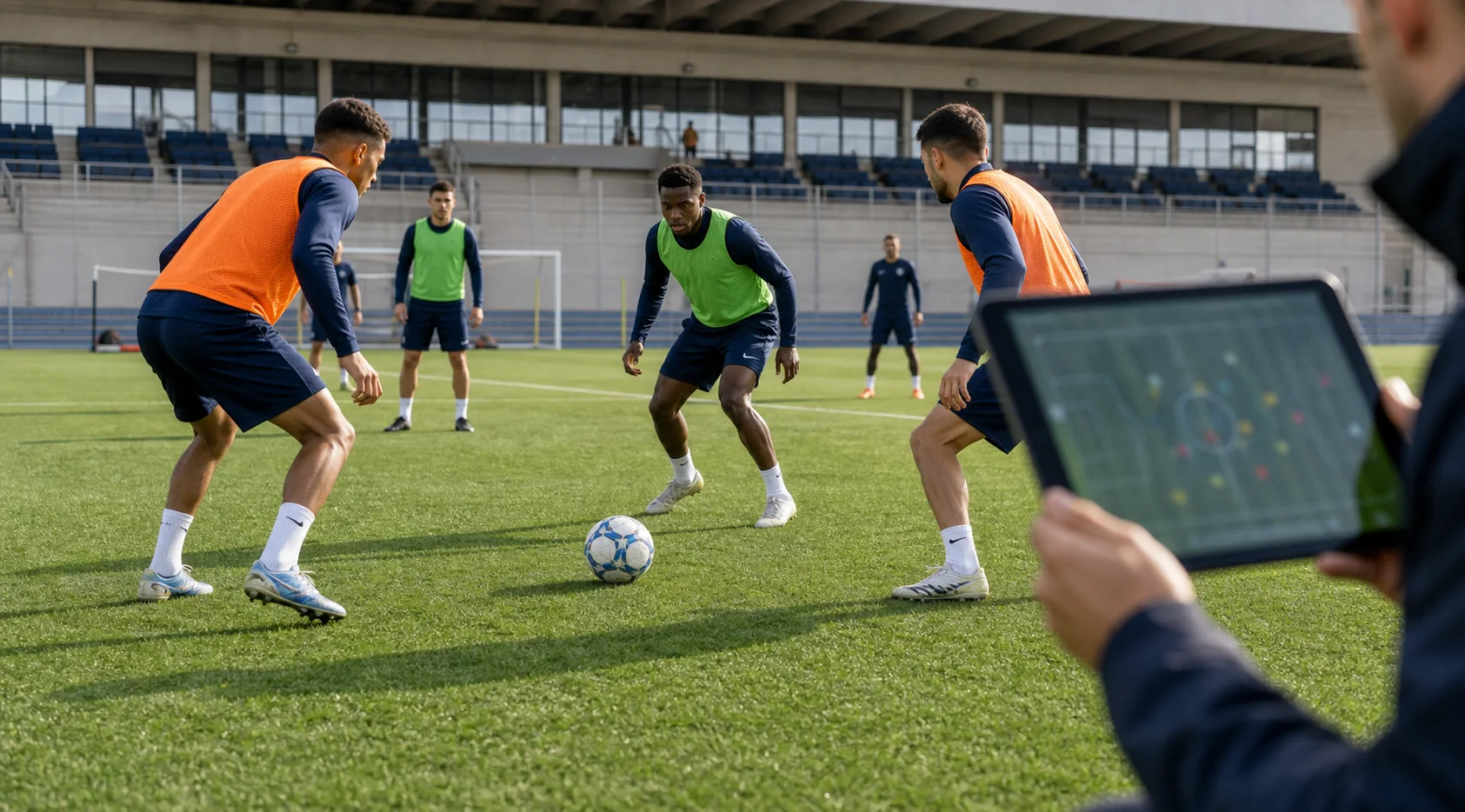
Pressing is a coordinated decision problem. A player’s sprint toward the ball only helps when teammates recognise the trigger, protect the next pass, and know how to recover if the first action is beaten. Start by describing the team’s pressing intention in one observable sentence, such as forcing play toward a covered side after a receiver takes a closed body shape. This gives the practice a shared purpose. Without it, coaches may celebrate effort while players learn conflicting rules about when to jump, hold, or screen. That decision should be captured in the session note, then checked against the athlete and coach response at the next review.
Design the first practice with a clear starting picture and a genuine choice for the attacking side. Position the ball, likely receiver, support options, and defensive cover so the trigger can appear rather than be announced. Use a scoring rule that values the collective result—forcing a predictable exit, regaining in a target zone, or delaying long enough to reset—rather than simply awarding every tackle. The attacking group must have enough space and options to punish an unrealistic press. That consequence is what teaches spacing and timing instead of choreographed closing down.
Progress through information, not only intensity. First let players recognise a slow, obvious cue; then change the receiver’s body shape, add a third-player option, or shorten the time between passes. Vary where the press begins so the rule is not tied to one painted area. Keep work-to-rest ratios appropriate for the physical aim, but do not confuse fatigue with tactical realism. If players are too exhausted to perceive the cue or communicate, the drill may train survival behaviour rather than the intended coordinated response. A brief note on context and outcome makes the next coaching decision easier, more transparent, and less dependent on memory.
Coach the relationships between players. The first presser needs a route, the nearest teammate needs an angle to cover the immediate escape, and the far side needs to squeeze without exposing an easy switch. Use short freeze moments to show the line of sight and passing lane, then restart quickly. Questions work well here: “If you go, who owns the inside pass?” or “What tells you the receiver cannot turn?” Keep feedback tied to visual information and collective action. A long lecture about effort usually obscures the tactical problem. Revisit the choice after a comparable task so the programme learns from a pattern rather than from a single impression.
Measure transfer with a mixed evidence set. Tag a sample of competitive sequences using the same trigger definitions, collect coach observations from practice, and ask unit leaders whether the language helped them act faster. Avoid judging the model only by recoveries; opponents, score state, and game plan affect those outcomes. Look as well at forced direction, delayed progression, compactness after the press, and whether players abandon the principle when the first action fails. Small samples should be described as illustrative, not converted into sweeping performance claims. This creates a practical feedback loop: decision, delivery, observation, and a proportionate adjustment for the following session.
The training dose requires deliberate management. Repeated accelerations, decelerations, and close-contact challenges can make a pressing drill physically costly even when the total duration is brief. Plan the block alongside speed work and match proximity, modify group sizes before reducing clarity, and maintain a safe surface and communication standard. Individual roles can be rotated to distribute exposure, but do not make every player perform every role if the tactical model assigns specialist responsibilities. The most useful drill is demanding enough to preserve the problem while still leaving athletes able to learn from it.
Close the cycle by linking video, drill, and match plan. Save a short clip that shows the intended trigger, write one coaching cue on the session card, and use that same cue in the next pre-match walkthrough. After competition, review a handful of sequences with the unit and decide whether the next practice should simplify, add an option, or address a different relationship. This loop keeps pressing work alive without replaying the same exercise. Players learn a transferable principle, while staff gain a disciplined way to improve it. Staff should record the adjustment, observe the next meaningful exposure, and revise the plan if the evidence changes.